

Is Your Child Living with Precocious Puberty?
Discover Hope Through Pediatric Clinical Trials
Precocious puberty is when a child’s body begins developing too early, usually before age 8 in girls and age 9 in boys. This early activation of puberty can cause rapid bone growth, advanced sexual development, emotional challenges, and potential long-term health risks. In many cases, the exact cause of precocious puberty is unknown. Rarely, certain conditions, such as infections, hormone issues, tumors, brain issues or injuries, may cause precocious puberty.
The most common form, central precocious puberty (CPP), happens when the brain signals the body to start puberty too soon. Left untreated, it may lead to shorter adult height, bone health issues, and significant psychological stress for children and families.
If your kid or someone you know has precocious puberty, Revival Research Institute is conducting Precocious Puberty Clinical Trials, investigating potential new treatment options.
Is this Clinical Trial the Right Fit for You?
To qualify for the Precocious Puberty Clinical Trials, participants must:
- Children (girls up to 8 years, boys up to 9 years)
- Diagnosed with central precocious puberty
- Onset of development of sex characteristics
*Additional criteria may apply.
Participation in the Precocious Puberty Clinical Trials is free of cost. To learn more or enroll, fill out the form below, and someone from our research team will contact you to discuss your potential eligibility for the study.
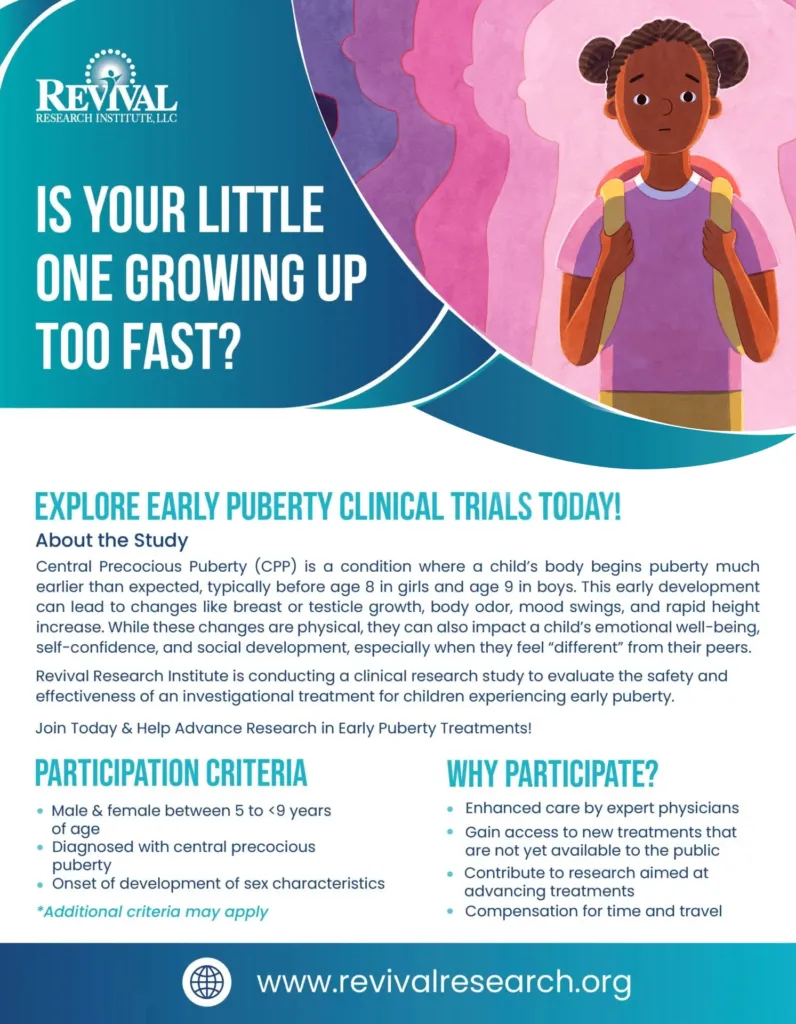
About Precocious Puberty Clinical Trials
Early puberty can be emotionally and physically challenging for children and families. It often brings unexpected changes that may affect a child’s confidence and overall well-being. Parents may also feel concerned or uncertain about how to best support their child during this rapid stage of development.
Revival Research Institute is conducting a clinical trial to evaluate the safety and effectiveness of an investigational treatment for children experiencing early puberty. The study aims to explore whether this treatment could potentially slow down puberty, helping children grow at a healthier pace while supporting their overall well-being.
The trial is being conducted at multiple sites across the United States, including locations in Texas. To participate, individuals must complete a screening process and agree to follow all study procedures. Eligible participants will be randomly assigned to receive either investigational treatment or a placebo.
All study-related procedures and treatments are provided at no cost. No insurance is required to participate, and eligible participants may receive compensation for time and travel.
Get Started
What to Expect?
If your child is experiencing early puberty, they may qualify for a paid clinical trial exploring new treatment options. After submitting the interest form above, a member of our research team will contact you for a brief pre-screening to determine if you meet the initial eligibility criteria.
If you qualify, you’ll be asked to review and sign an Informed Consent Form (ICF), which outlines all study procedures, potential benefits, and possible risks. Once consent is given, you will be invited to one of Revival’s research sites in Texas for a screening visit. During this visit, we’ll review your medical history, conduct physical exams, and perform lab tests to confirm your eligibility. Participants who meet all study requirements will be enrolled in the Precocious Puberty Clinical Trial.
Our team is committed to ensuring you fully understand your role in the study and what to expect throughout. Please don’t hesitate to ask questions before making your decision. Your involvement helps advance future treatment options for early puberty.

Age

Condition

Location
Understanding Early Puberty In Children

Precocious puberty occurs when a child’s body begins showing signs of puberty earlier than expected, typically before age 8 in girls and age 9 in boys. It can result from conditions affecting the brain such as hypothalamic or pituitary abnormalities, tumors, or genetic factors. This early onset of puberty can lead to rapid bone growth, early menstruation in girls, voice deepening in boys, and emotional or social challenges due to the mismatch between physical development and emotional maturity.
Key areas affected include physical growth, hormonal balance, and psychosocial well-being. If left untreated, precocious puberty may result in reduced adult height because bones mature too quickly, as well as potential difficulties with self-esteem and peer relationships. Over time, children may also experience mood changes, anxiety, and challenges in adapting socially.
Early puberty can be caused by:
- Pituitary tumors or surgery
- Traumatic brain injury
- Radiation therapy
- Autoimmune inflammation
- Idiopathic causes (no known cause)
Common Symptoms of Early Puberty Include:
- Early breast or testicular development
- Rapid growth or advanced bone age
- Early menstruation in girls
- Mood swings, emotional challenges, and social stress
- Shorter predicted adult height
Frequently Asked Questions
Your Guide to Early Puberty in Children
Got questions about early puberty? You’re not alone.
We’ve compiled answers to some of the most common questions about the condition—what causes it, how it’s treated, and what life with early puberty can look like. Still can’t find what you’re looking for? Our team is here to help. Call us on +1 (248) 721-9539, and we’ll be happy to assist you.
What is precocious puberty?
Precocious puberty occurs when puberty begins too early, before age 8 in girls and 9 in boys. Central precocious puberty is caused by premature activation of the brain-pituitary-gonadal axis.
Can early puberty be delayed or treated?
Yes, certain hormone treatments can help pause or delay puberty until the child reaches a normal age for development. Clinical trials are testing new therapies to improve these outcomes.
What happens if precocious puberty is not treated?
Without treatment, children may stop growing too early, resulting in shorter adult height. Emotional and social challenges may also arise.
How is precocious puberty diagnosed?
Diagnosis usually involves a physical exam, hormone level testing, bone age X-rays, and sometimes brain imaging to identify the cause.
Why should my child participate in a clinical trial?
By enrolling in a precocious puberty clinical trial, your child may access investigational treatment at no cost, receive care from pediatric specialists, and help advance future therapies for CPP and pediatric endocrinology