

Living with Chronic Inflammatory Demyelinating Polyneuropathy (CIDP)?
Clinical Trials May Help Explore Potential Treatment Options
Chronic Inflammatory Demyelinating Polyneuropathy (CIDP) is a rare neurological disorder in which the immune system attacks the protective myelin covering of the peripheral nerves. As that covering is damaged, nerve signals slow down or stop getting through, which leads to progressive weakness, numbness, tingling, and loss of function, most often in the legs and arms.
CIDP can follow a steadily progressive course or a relapsing and remitting one. Many people find that their symptoms are controlled only as long as treatment continues, and that function declines again when treatment is reduced or delayed. Fatigue, difficulty walking, trouble with balance, and loss of hand strength are common parts of daily life with the condition.
If you are an adult living with a confirmed diagnosis of CIDP and you currently depend on treatment to manage it, Revival Research Institute is conducting CIDP Clinical Trials evaluating an investigational treatment approach for adults with this condition.
Are You Eligible to Participate?
- Be an adult male or female, 18 years of age or older
- Have a documented diagnosis of CIDP confirmed by a physician
- Currently be receiving and dependent on immunoglobulin therapy, corticosteroids, or another standard treatment for CIDP
- Have ongoing difficulty with walking, arm function, or hand function due to CIDP
- Have had stable symptoms and a stable treatment dose for the past 12 weeks
*Additional criteria may apply.
Participation is free of cost. To learn more or determine whether you may qualify, complete the form below. A member of our research team will contact you to discuss potential eligibility.
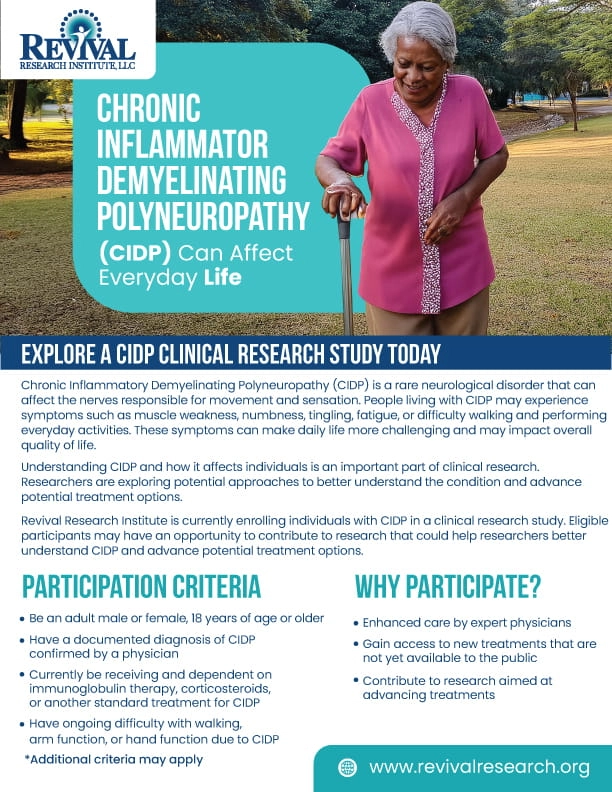
About Chronic Inflammatory Demyelinating Polyneuropathy Clinical Trials
Managing CIDP usually means ongoing treatment, regular monitoring, and periodic adjustment as symptoms change. Because response varies from person to person, and treatment often has to continue indefinitely, patients and neurologists continue to look for additional options.
Revival Research Institute is conducting CIDP research studies in Texas for adults with a documented diagnosis of Chronic Inflammatory Demyelinating Polyneuropathy who remain dependent on treatment. The study is designed to evaluate the safety and efficacy of an investigational intravenous immunoglobulin therapy being studied for CIDP.
An important point about this study: participants must first have their current CIDP treatment reduced and then stopped, under close supervision from the study team, so the study can confirm that their disease is still active and still treatment dependent. Participants are seen every three weeks during this period and are moved into the treatment phase of the study as soon as any worsening is confirmed, so that further decline is avoided. This is discussed in full detail with you and your physician before you make any decision to take part.
**All study-related procedures and study treatments are provided at no cost to eligible participants. No insurance is required to participate.
*To take the next step, submit the form above, and our research staff will contact you to determine if you qualify. A brief discussion about your health and medical history may be required..
Get Started
What to Expect?
If you are an adult living with CIDP, you may qualify for CIDP Clinical Trials exploring potential treatment options. After completing the interest form above, a member of our research team will contact you for a brief pre-screening discussion to determine whether the initial eligibility requirements are met.
If you appear to qualify, an Informed Consent Form (ICF) will be reviewed and signed. This document explains the study procedures, the treatment reduction period, potential risks, possible benefits, and participant responsibilities before any decision to participate is made. You are free to ask questions at any point and free to withdraw at any time.
Once consent is provided, you will be invited to one of Revival Research Institute’s study sites for screening evaluations. These assessments may include a physical and neurological examination, review of medical history and prior CIDP treatment, vital signs, laboratory testing, disability and strength assessments, and other evaluations required by the study protocol.
Participants who meet all study requirements may be enrolled in the study. Our team will make sure you and your loved one fully understand what participation involves and what to expect throughout the study duration. You are encouraged to ask questions at any time.

Age

Condition

Location
Chronic Inflammatory Demyelinating Polyneuropathy A Rare Autoimmune Nerve Disorder

CIDP May Present Through
- Progressive weakness in the arms and legs, usually on both sides
- Numbness, tingling, or loss of sensation in the hands and feet
- Difficulty walking, climbing stairs, or rising from a seated position
- Loss of grip strength and difficulty with buttons, keys, or utensils
- Loss or reduction of deep tendon reflexes
- Persistent fatigue
Common Features Associated with CIDP Include
- A course that either progresses steadily or relapses and remits over time
- Symptoms that develop gradually, typically over eight weeks or longer
- Ongoing dependence on treatment to maintain function
- Return or worsening of symptoms when treatment is reduced or delayed
- Reduced mobility and increasing difficulty with everyday tasks
- Impact on work, independence, and quality of life
Frequently Asked Questions
Your Guide to Chronic Inflammatory Demyelinating Polyneuropathy
Got questions about CIDP? You’re not alone. We’ve compiled answers to some of the most common questions about CIDP, including its causes, symptoms, diagnosis, treatment, and clinical trial participation. Still have questions? Contact our research team for more information. Call us at +1 (248) 721-9539, we’ll be happy to assist you.