

Seeing Confusion or Behavior Shifts in Alzheimer’s?
Explore Clinical Trials That Could Shape Future Treatments
Psychosis in Alzheimer disease refers to the presence of delusions, hallucinations, or other distortions of reality. It is estimated to affect around 40% of people with Alzheimer’s. Delusions often involve false beliefs or misinterpretations of situations, such as thinking a family member is an imposter or believing that belongings have been stolen. Hallucinations, on the other hand, involve perceiving things that are not present, like seeing or hearing things that others do not. The exact cause of psychosis in Alzheimer’s is not fully understood, but it’s believed to be related to the complex changes happening in the brain.
Revival Research Institute is conducting clinical research to find new treatment options that may help people manage their psychotic symptoms.
Are You Eligible to Participate?
- Age 55 to 90 years old
- BMI ≥18.5 kg/m2
- Meets clinical criteria for Possible or Probable Alzheimer’s disease
*Additional Criteria may apply.
Participation in Alzheimer’s disease psychosis clinical trials provides a chance to receive expert care, free study-related medication, and regular health monitoring by experienced medical professionals.
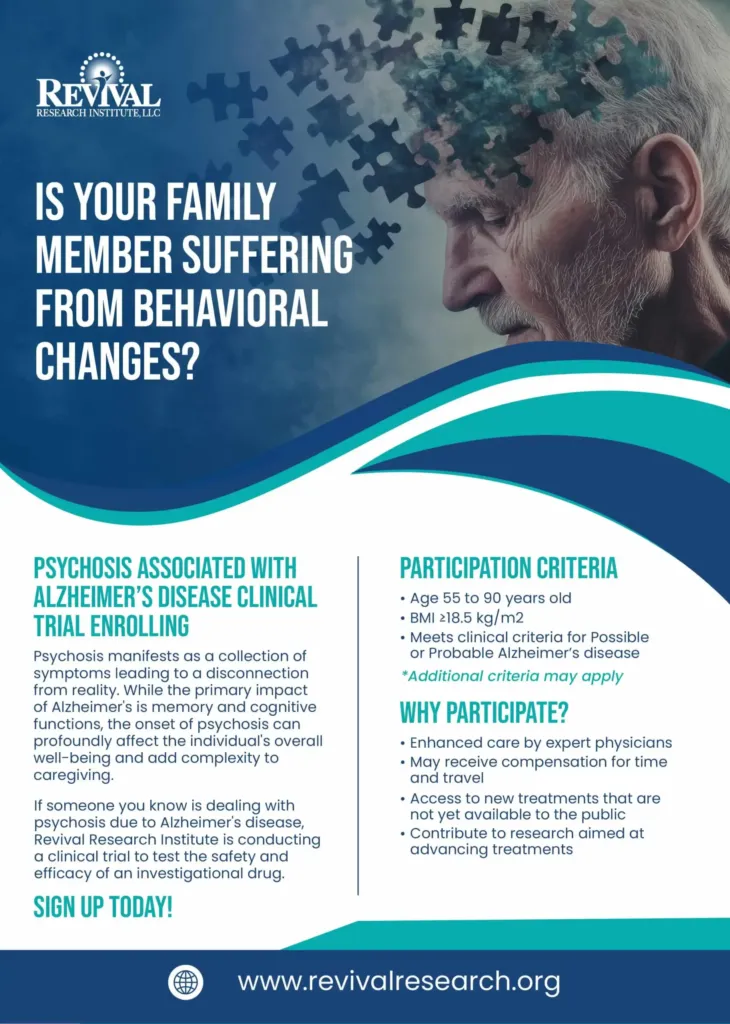
About the Alzheimer’s Disease Psychosis Clinical Trials
Psychosis in Alzheimer’s disease is a distressing and challenging aspect of the illness, often presenting in the later stages. We are conducting Alzheimer’s Disease Psychosis Clinical Trials to assess the efficacy and safety of an oral drug in older adults males and females with psychotic symptoms.
Revival Research Institute is conducting clinical trials to evaluate an investigational therapy designed to specifically target Psychosis Associated with Alzheimer’s Disease.
All study-related care, including medical evaluations, lab tests, and investigational medication, is provided at no cost, and insurance is not required to participate. Eligible participants may also receive compensation for their time and travel.
If you’re interested in learning more, complete the form above, and a member of our research team will contact you to discuss your eligibility. A brief conversation about your health and medical history will help determine if a clinical trial may be right for you.
Get Started: What to Expect?
If you are suffering from Alzheimer’s disease psychosis and would like to participate in our paid clinical research study in Texas. After completing the interest form above, a research team member will contact you for a brief pre-screening to review your health history and determine eligibility.
If you appear eligible, you’ll be invited to a screening visit at our clinical research site. During this visit, medical staff will review your history, perform basic exams, and run lab tests to confirm eligibility. Before any procedures begin, you’ll be asked to review and sign an Informed Consent Form (ICF) that outlines the study’s purpose, procedures, and potential risks and benefits.
Our team will ensure you fully understand your role in the study and what to expect throughout participation. You are encouraged to ask questions at any stage. Your participation helps advance research toward future treatment options for Alzheimer’s disease psychosis.

Age

Condition

Location
Understanding Alzheimer’s Disease Psychosis

Psychosis in Alzheimer’s disease manifests through various distressing symptoms. Hallucinations, where individuals see, hear, or sense things that aren’t actually present, become common. Delusions, involving strongly held false beliefs, may also emerge. These symptoms contribute to increased confusion, anxiety, and behavioral changes, often challenging both the affected individuals and their caregivers.
Causes of Psychosis in Alzheimer's disease
- Neurodegeneration
- Chemical imbalances in brain signaling
- Amyloid plaques and tau protein buildup
- Brain inflammation
- Structural changes in areas controlling perception
- Reduced blood flow to the brain
Risks and Symptoms of Psychosis in Alzheimer's disease
- Advanced age
- Genetic risk (APOE-ε4)
- History of depression or mental illness
- Certain medications
- Advanced Alzheimer’s progression
Frequently Asked Questions
Your Guide to Common Questions
We’ve gathered answers to some of the most common questions about what causes Psychosis in Alzheimer’s disease, how it can be managed, and what steps you can take to protect your mental health. Still have questions? Our team is here to help. Call us at +1 (248) 721-9539 — we’ll be happy to assist you.