

Is Your Butterfly Rash Disrupting Daily Life?
Cutaneous Lupus Erythematosus Clinical Trials May Be an Option!
Cutaneous Lupus Erythematosus (CLE) is a chronic autoimmune disease that causes red, scaly rashes to appear on the skin. It may occur with or without systemic lupus erythematosus (SLE). CLE can lead to disfigurement and permanent skin damage, significantly impacting quality of life. The most recognizable form is the butterfly-shaped rash across the cheeks and nose. In individuals with CLE, the immune system mistakenly attacks healthy skin cells, leading to inflammation, lesions, and long-term scarring.
The Lupus Foundation of America estimates that 1.5 million Americans are living with some form of lupus. Around 90% of those affected are women, with most developing the disease between the ages of 15 and 44. The emotional and physical toll of skin lupus can be profound, especially when flare-ups affect visible areas of the body like the face, arms, or scalp.
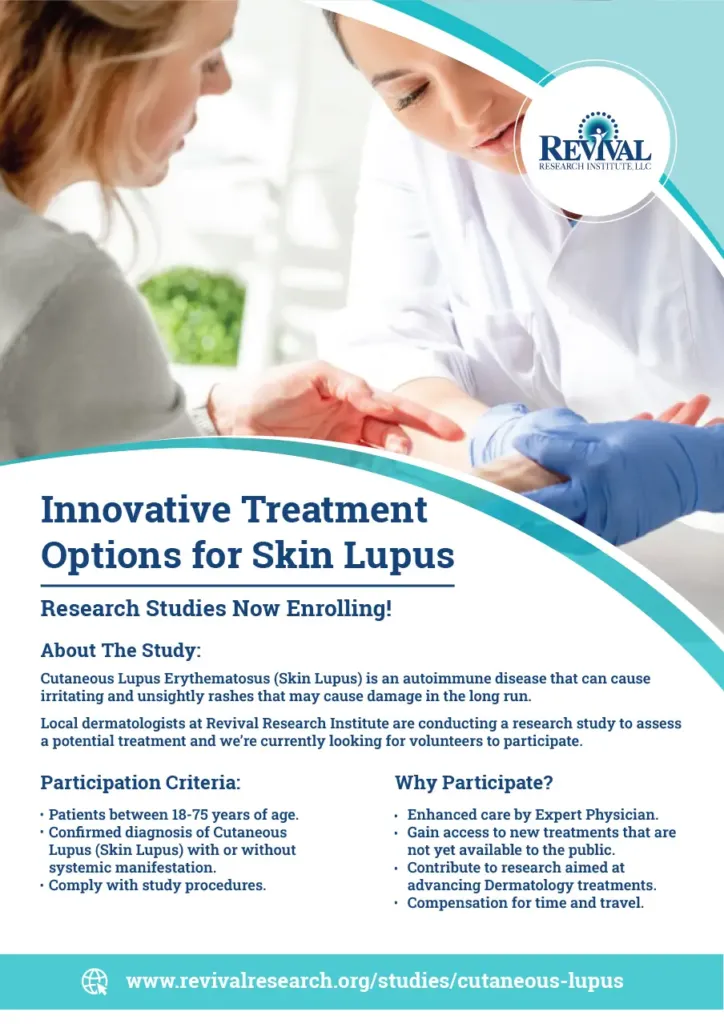
Revival Research Institute is conducting clinical trials to investigate an investigational drug that may help improve symptoms in people diagnosed with chronic or subacute cutaneous lupus erythematosus.
Are You Eligible to Participate?
To qualify for the Skin Lupus Clinical Trials, participants must:
- Be at least 18 years or older
- Have been diagnosed with Chronic or Subacute Cutaneous Lupus
- Have at least 1 active skin lupus rash anywhere on your body
*Additional criteria may apply.
Participation in the Skin Lupus Clinical Trials is free of cost. To learn more or enroll, fill out the form. A member of our research team will contact you to discuss your potential eligibility for the study.
About Cutaneous Lupus Erythematosus Clinical Trials
Living with Cutaneous Lupus Erythematosus can be physically painful and emotionally distressing. The persistent rash, scarring, and flare-ups can disrupt daily life, lead to self-consciousness, and lower confidence.
Revival Research Institute is conducting a clinical trial for individuals with moderate to severe cutaneous lupus erythematosus. This study is designed to evaluate the safety and efficacy of an investigational treatment that may help improve symptoms of this condition.
Clinical trials will be conducted at multiple locations across the United States, including Michigan and Georgia. To qualify, participants must complete a screening process and comply with all study procedures. Those who meet eligibility criteria and are selected for the study will receive either investigational treatment or a placebo.
*All study procedures and study-related treatments, including the investigational drug, are provided at no cost, and no insurance is required to participate, and participants may receive compensation for time and travel.
*To take the next step, submit the form above, and our research staff will contact you to determine if you qualify for the study. A brief discussion about your health and medical history may be required.
Get Started
What to Expect?
After you complete the interest form above, a member of our research team will reach out to conduct a brief pre-screening call to determine if you meet the initial eligibility criteria. If you qualify, the second part of the screening will take place at one of Revival’s research sites. During this on-site visit, you will review and sign an Informed Consent Form (ICF), which explains all study procedures, potential risks, and possible benefits. The visit will also include a review of your medical history, physical examination, and lab tests to further assess your eligibility. If you meet all study requirements, you may be officially enrolled in the Cutaneous Lupus Erythematosus Clinical Trial.
Our team is committed to ensuring you fully understand your role in the study and what to expect throughout. Please feel free to ask any questions before deciding to participate. Your involvement helps advance future treatment options for cutaneous lupus erythematosus.

Age
18 years or older

Condition
Cutaneous Lupus Erythematosus

Location
Michigan
Cutaneous Lupus: A Chronic Autoimmune Skin Disease

Cutaneous Lupus Erythematosus (CLE) is a rare autoimmune skin disorder where the body’s immune system attacks healthy skin cells, causing inflammation and damage. CLE can appear in different forms—chronic or subacute, and often results in long-lasting or recurring rashes. While some cases remain limited to the skin, others may occur in individuals who also have systemic lupus erythematosus (SLE).
Lesions often develop on sun-exposed areas such as the arms, neck, chest, and face. These rashes may become scaly, discolored, or scarred over time, particularly if left untreated. CLE flare-ups are not only physically uncomfortable but can also lead to increased emotional stress and decreased self-confidence. Because it is a chronic and often visible condition, many individuals struggle to find lasting relief or treatment options that consistently work.
Cutaneous Lupus Erythematosus May Be Triggered By
- Genetic predisposition (family history of autoimmune conditions)
- Exposure to ultraviolet (UV) light
- Certain prescription medications
- Hormonal fluctuations (especially in women)
- Environmental stressors or infections
Common Symptoms of Cutaneous Lupus Erythematosus
- Scaly, inflamed, or coin-shaped skin lesions
- Sensitivity or flare-ups after sun exposure
- Pigment changes or permanent scarring
- Discomfort such as burning, pain, or skin tenderness
Frequently Asked Questions
Your Guide to Skin Lupus
Got questions about Cutaneous Lupus Erythematosus? You’re not alone.
We’ve compiled answers to some of the most common questions about the condition—what causes it, how it’s treated, and what daily life with lupus can look like. Still can’t find what you’re looking for? Our team is here to help. Call us on (248) 721-9539, and we’ll be happy to assist you.
What is Cutaneous Lupus Erythematosus?
CLE is an autoimmune disease where the immune system attacks skin cells, causing inflammation, rashes, and lesions. It can exist alone or with systemic lupus.
Is CLE contagious?
No, lupus—cutaneous or systemic—is not contagious. It cannot be passed from one person to another.
Can you have systemic lupus and CLE together?
Yes. Many individuals with systemic lupus erythematosus (SLE) also experience CLE. However, CLE can also occur on its own.
What is the cost of participating in a research study?
There’s no cost to participating in our lupus clinical trials, as we cover all the expenses ourselves, including travel and participation costs.
Can I leave the study once I join?
Yes. Participation is completely voluntary. You can leave the study at any time without any cost to you or your health insurance.