

Explore Breakthroughs in Cancer Care and Precision Medicine

Studies
Oncology Clinical Trials in Texas
At Revival Research Institute, we are conducting oncology clinical trials in Nebraska to support patients with navigating cancers such as advanced solid tumor, metastatic breast cancer, multiple myeloma, and lung cancer. Our team is also preparing additional studies designed to open doors to more advanced and targeted treatment options. Every trial is carried out with close medical oversight to ensure safety, integrity, and compassionate care. Our goal is to bring promising investigational therapies within reach for individuals seeking new hope and better outcomes in their cancer treatment journey.
Metastatic Breast Cancer
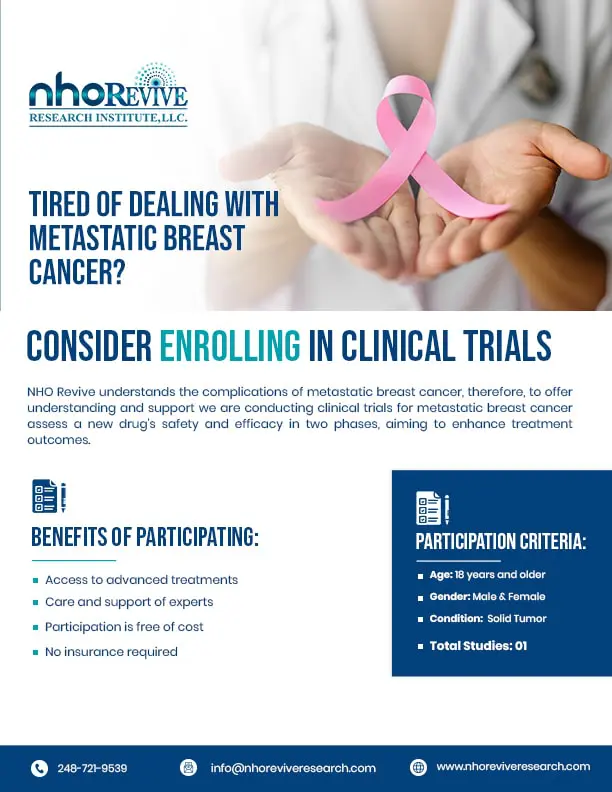
Metastatic breast cancer, also known as stage IV breast cancer, presents a significant oncological challenge with a 5-year relative survival rate of around 27%. This aggressive form of cancer can spread to distant organs, complicating treatment and making the journey particularly difficult for those affected. Survival rates can vary based on factors like the type of metastases and treatment efficacy. In contrast, early detected breast cancer, confined to the breast and nearby lymph nodes, has a 5-year relative survival rate often exceeding 90%.
NHO Revive is acutely aware of the challenges posed by metastatic breast cancer and is actively conducting research to explore potential therapeutic options. Our commitment is to provide exceptional care and unwavering support throughout your participation in our clinical trials for cancer, aiming to improve outcomes and offer hope to those on this journey.
Age
18 Years and older
Gender
Male and Female
Condition
Recruiting
Current Status
Recruiting
Location
Nebraska
Advanced Solid Tumor
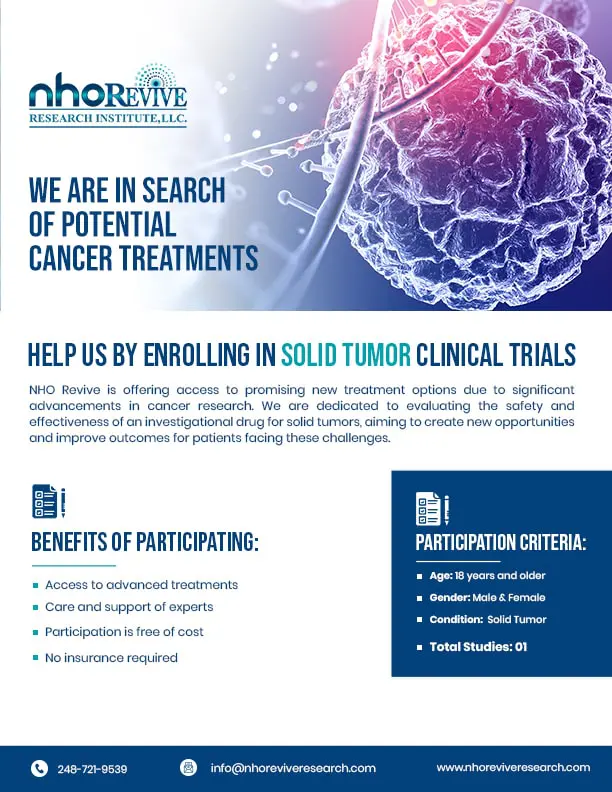
Advanced solid tumors are abnormal masses that typically lack cysts or liquid areas, accounting for approximately 90% of adult cancers. These tumors can be benign or malignant and are classified based on their originating cell type, such as sarcomas, carcinomas, and lymphomas. Unlike solid tumors, leukemias (blood cancers) generally do not form solid masses.
NHO Revive recognizes the challenges posed by advanced solid tumors and is actively conducting research studies to explore potential treatments. Our mission is to provide exceptional care and unwavering support throughout your journey in our clinical trials for cancer.
Age
18 Years and older
Gender
Male and Female
Condition
Solid Tumors
Current Status
Recruiting
Location
Nebraska
Diffuse Large B-Cell Lymphoma
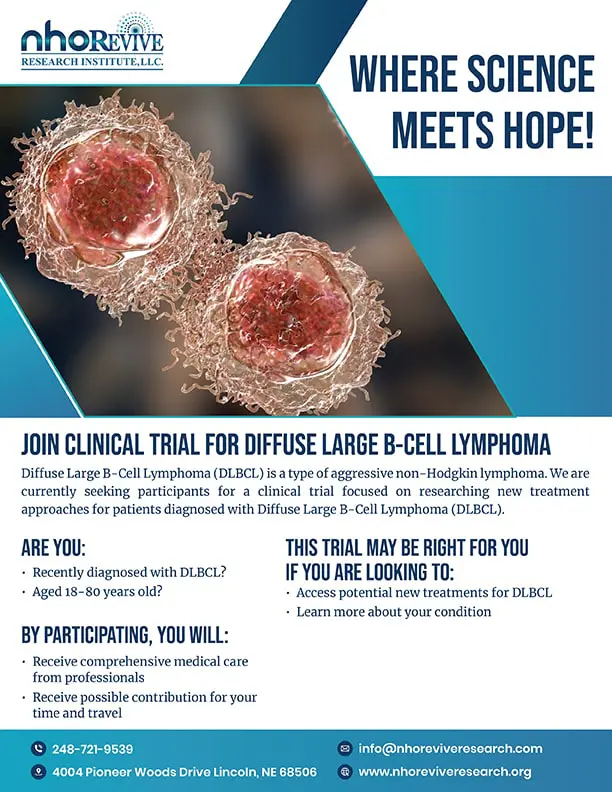
Diffuse Large B-Cell Lymphoma (DLBCL) is the most common subtype of non-Hodgkin lymphoma, accounting for 85% of cases. It results from genetic mutations that transform healthy B-cells into fast-growing cancer cells, which can spread rapidly to lymph nodes and other organs. About 60-70% of patients achieve long-term remission, with prognosis influenced by factors like age, overall health, and disease stage. Early detection and personalized treatment are crucial for better outcomes. Some cases resist standard treatments, prompting researchers to explore alternative therapies.
At NHO Revive, we are committed to developing new treatments for DLBCL through innovative clinical trials. Our clinical trial for cancer focuses on creating novel drugs that target the underlying mechanisms of the disease, aiming to improve patient outcomes and offer new hope in the fight against this aggressive cancer.
Age
18 –79 Years
Gender
Male and Female
Condition
DLBCL
Current Status
Recruiting
Location
Nebraska
Refractory Multiple Myeloma
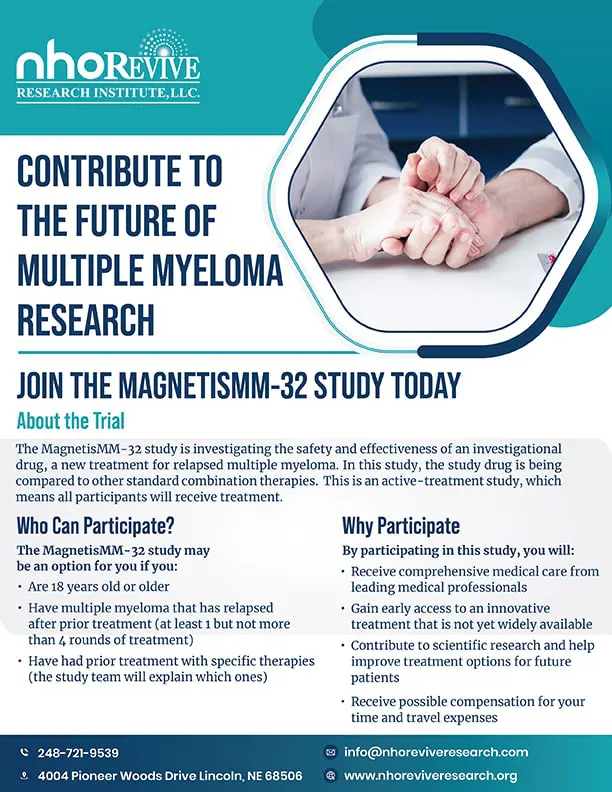
Refractory multiple myeloma is a type of blood cancer that begins in plasma cells, a kind of white blood cell in the bone marrow. These malignant plasma cells can accumulate, forming tumors in bones such as the spine, skull, pelvis, and ribs. The disease can progress rapidly, causing symptoms like bone pain, fractures, anemia, and kidney dysfunction.
NHO Revive is conducting clinical trials for cancer to evaluate an investigational drug for refractory multiple myeloma, comparing its efficacy to existing treatments. This research aims to determine the drug’s effectiveness and safety, potentially offering improved treatment options for patients with this form of cancer. By participating in clinical trials for oncology, patients can contribute to advancements in multiple myeloma therapy and access new, potentially more effective treatments.
Age
18 –79 Years
Gender
Male and Female
Condition
Multiple Myeloma
Current Status
Recruiting
Location
Nebraska
Myelofibrosis
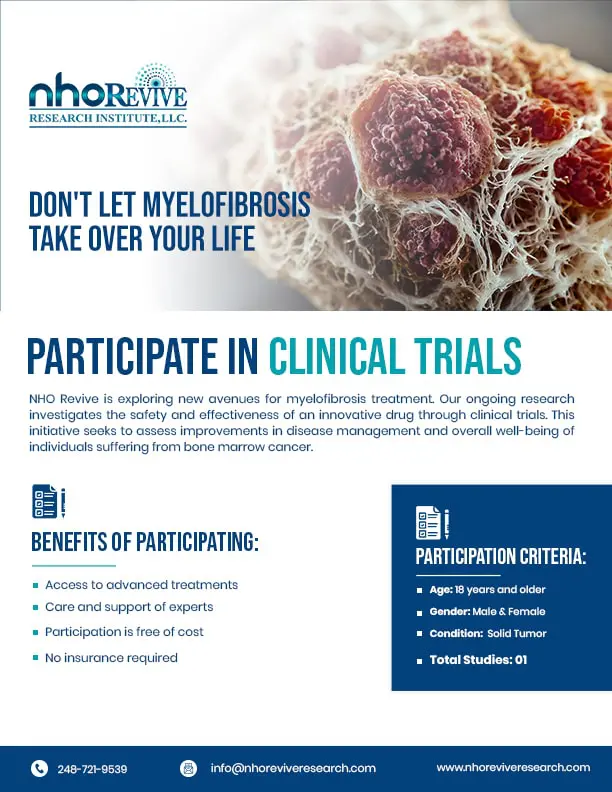
Myelofibrosis is a rare bone marrow cancer that disrupts normal blood cell production, affecting 1 to 9 in every 100,000 people. This condition causes significant scarring in the bone marrow, leading to severe anemia, which results in weakness and fatigue. The scarring also reduces platelet numbers, increasing bleeding risk, and often causes an enlarged spleen. Myelofibrosis can occur independently (primary) or develop from another bone marrow disorder (secondary).
NHO Revive’s myelofibrosis clinical trial for cancer aims to investigate the safety and efficacy of an investigational drug with the potential to effectively target this cancer. Our commitment is to bring innovative treatments to patients, enhancing their well-being and quality of life.
Age
≥ 18 years
Gender
Male and Female
Condition
Myelofibrosis
Current Status
Recruiting
Location
Nebraska
Non-Small Cell Lung Cancer
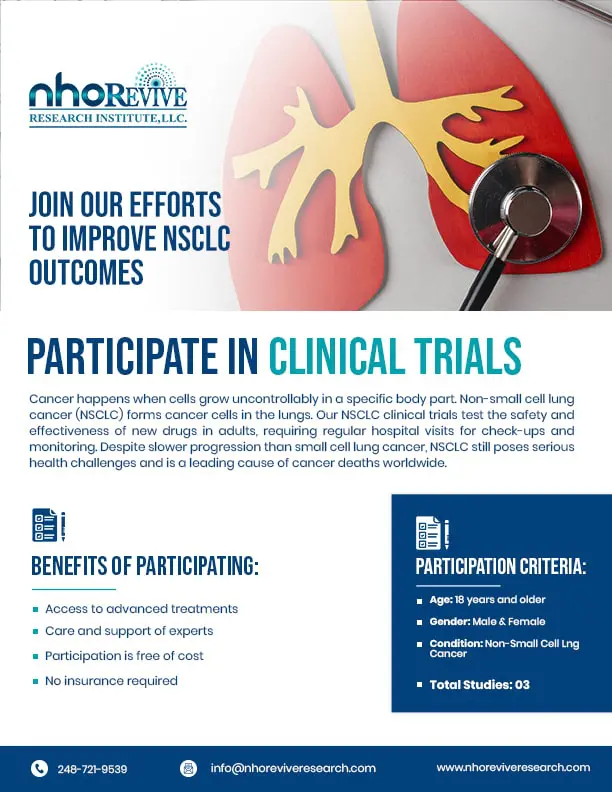
Cancer occurs when cells in a specific part of the body reproduce uncontrollably. Non-small cell lung cancer (NSCLC) forms cancerous cells in lung tissues. Our clinical trials for cancer aim to compare the effectiveness and safety of investigational drugs in adult participants against current lung cancer treatments. This study will assess changes in disease activity and associated effects.
Although NSCLC spreads more slowly than small cell lung cancer, it still presents significant challenges and is a leading cause of cancer-related mortality worldwide. Participants in our trials must attend regular hospital visits for check-ups, blood tests, side effect monitoring, and complete questionnaires. Clinical trials for cancer are essential to evaluate the treatment’s impact and ensure comprehensive care.
Age
18 years and older
Gender
Male and Female
Condition
NSCLC
Current Status
Recruiting
Location
Nebraska