

Patches of Hair Loss? Don’t Stress It.
Explore Your Options by Participating in Alopecia Areata Clinical Trials
Alopecia Areata is a chronic autoimmune condition in which the body’s immune system mistakenly targets and attacks healthy hair follicles, leading to sudden and often unpredictable hair loss. This hair loss typically appears as small, round, smooth patches on the scalp but can also affect other hair-bearing areas of the body, such as eyebrows, eyelashes, beard, and limbs. While the severity and pattern of hair loss vary from person to person, alopecia areata can affect individuals of all genders, ages, and ethnic backgrounds.
Fortunately, advancements in medical research have opened promising avenues for the treatment of alopecia areata. Revival Research Institute is currently conducting Alopecia Areata Clinical Trials in Michigan, offering individuals affected by hair loss the chance to take part in a research study. These clinical trials are designed to evaluate the safety, tolerability, and efficacy of an investigational medication that may potentially help restore hair growth and improve the quality of life for those living with alopecia areata.
Interested in Participating in an Alopecia Areata Clinical Trial?
To be eligible for Alopecia Areata Clinical Trials, individuals must meet the following criteria:
- Aged 18 years or older
- Suffering hair loss in small or round patches
*Additional Criteria may apply.
We are conducting Alopecia Areata Clinical Trials for hair loss. This could be a potential breakthrough against hair loss. To participate in the clinical trial, please fill out the form below, and someone from our research team will reach out to you. The study drug and study-related care will be provided at no cost. No insurance is required to participate.
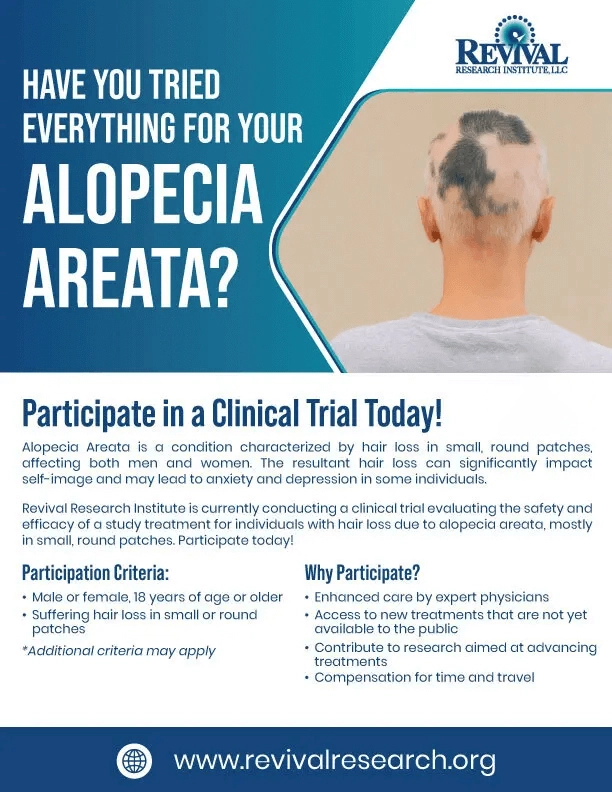
Alopecia Areata Clinical Trials: Investigating Treatment Options for Hair Loss
Revival Research Institute is conducting multiple clinical trials for Alopecia Areata in different locations including Michigan and Georgia. These studies are designed to explore potential new treatments that may help reduce hair loss, promote hair regrowth, and improve overall quality of life. If you qualify for one of our studies, you may receive either an investigational treatment or a placebo at no cost, along with study-related care and regular health assessments.
Participation is entirely voluntary, and you can choose to withdraw at any time. Each study has specific eligibility criteria, which will be discussed with you during the screening process. By taking part, you’re not only exploring new options for managing your condition but also helping advance research for future Alopecia Areata treatments.
All study procedures and study-related treatments, including the investigational drug, are provided at no cost, and no insurance is required to participate, and participants may receive compensation for time and travel. To take the next step, submit the form above, and our research staff will contact you to determine if you qualify for the study.
Get Started: What to Expect?
After you fill out the form above, a member of our research team will contact you for a brief phone screening. This initial call helps us determine whether you may qualify for one of our dermatology clinical trials in Michigan. If you appear eligible, you will be invited to the research site for an in-person screening visit. During this visit, the study team will conduct physical assessments, review your medical history, and guide you through the informed consent process. You will also receive detailed information about the study, including its potential risks and benefits.
If you meet all the eligibility criteria and choose to participate, you will be officially enrolled in the trial. Throughout the study, our team will closely monitor your health and track any side effects or changes in your health to ensure your safety and well-being.

Age
18 years or older

Condition
Alopecia Areata

Location
Georgia & Michigan
About Alopecia Areata

Alopecia is the medical term for hair loss, while alopecia areata specifically refers to a type of hair loss characterized by sudden, patchy bald spots on the scalp or other parts of the body. Alopecia areata can occur both in males and females as well. The alopecia most observed in men is known as androgenic alopecia.
Most of the individuals with this condition are healthy and have no other symptoms. However, it varies from person to person. Few individuals have bouts of hair loss throughout their entire lives, while others may only face a single episode. Alopecia areata is seen to begin with sudden loss of round or oval patches mainly on the scalp, but it can also affect other areas such as beard in men, or the eyelashes or eyebrows in both. It results in visible patches of baldness, but the most noticeable damage it does is to one’s self-image and confidence, which is why Revival Research Institute is conducting clinical trials for alopecia areata.
Alopecia Areata May Be Triggered By
- Autoimmune response (the body’s immune system attacks hair follicles)
- Genetic predisposition (family history of alopecia or other autoimmune conditions)
- Severe emotional or physical stress
- Environmental factors (exposure to viruses or toxins)
- Other autoimmune disorders (like thyroid disease, vitiligo, or type 1 diabetes)
Common Symptoms of Alopecia Areata
- Sudden round or oval bald patches on the scalp or other body parts
- Tingling, itching, or burning sensation before hair loss
- Loss of eyebrow, eyelash, or beard hair
- Visible nail changes (pitting, ridges, or white spots)
- Regrowth of fine, white, or lighter-colored hair
Frequently Asked Questions
Your Guide to Common Questions
Have a look at some of our most frequently asked questions regarding clinical trials and what they’re all about. If you can’t find the answer you’re looking for, call us at: +1 (248) 721-9539.
What is alopecia areata?
Alopecia areata is an autoimmune condition where the immune system mistakenly attacks hair follicles, leading to hair loss in small, round patches on the scalp. It is a prevalent condition that affects both men and women. Moreover, it can also occur in other hair-bearing areas of the body.
What causes alopecia areata?
Alopecia areata is marked by an inflammatory process, though its exact pathophysiology is not fully understood. This lack of clarity is why clinical research is essential, helping researchers and doctors gain a deeper understanding of the condition. It is believed that the development of alopecia areata is influenced by both genetic predisposition and environmental factors, such as exposure to toxic agents.
Does stress contribute to alopecia areata?
There are various factors that contribute to alopecia areata, including the potential influence of stress. In this condition, the body’s immune system targets hair follicles, which further leads to hair loss.
Who can enroll in Alopecia Areata Clinical Trials in Michigan?
Healthy individuals who are above the age of 18 years and suffer from hair loss in small or round patches on the scalp or other hair-bearing areas of the body are eligible to enroll. Participants should be willing to maintain the same hairstyle, hair length, hair color, hair care products like shampoo, and habits throughout the potential treatment for alopecia areata. When you contact the study team, they will let you know of the additional participation criteria.
Is alopecia areata treatable?
Enrolling in Alopecia Areata Clinical Trials that is investigating potential treatments for alopecia areata, may offer opportunities to explore effective solutions and help you potentially regain confidence and hair growth.
What are the types of alopecia areata?
Three main types of alopecia areata are:
Patchy Alopecia Areata: In this type, hair loss occurs in coin-sized patches on the scalp or other parts of the body.
Alopecia Totalis: In this type of alopecia areata, there is loss of entire or nearly all hair on the scalp.
Alopecia Universalis: In this kind, there is complete or almost loss of hair on the scalp, face, and rest of the body.
Will I be compensated for my time and travel in the Alopecia Areata Clinical Trials for hair loss?
If you are eligible and decide to participate in the Alopecia Areata Clinical Trials in Michigan, you will receive reimbursement for your time and travel. The study drug and any study-related procedures will be provided to you at no cost.